

A patient picks up two blister packs from the same manufacturer. Both are white. Both have small print. One is a prescription medication for blood pressure, the other an antiviral for a chronic condition. Without reading carefully, and under the stress of daily life, errors happen. They happen more than we admit. Packaging confusion is not a minor inconvenience; it is one of the most persistent barriers to correct medication use across European healthcare systems.
Color-coded packaging addresses this problem directly. By assigning distinct visual identities to drug types, dosing times, or risk levels, packaging designers give patients a second layer of information that works even when they can’t, or don’t, read the label in full. The evidence for this approach has grown steadily over the past two decades, and the practical implications reach every category of medication, from long-term cholesterol therapies to short-course antivirals, from antiviral medication for hepatitis b to daily medication for gout.
At HCPC Europe, our work centers on the idea that packaging is not just a container, but a communication tool. The right visual cues, applied consistently, help patients take the right dose, at the right time, for the right duration. That principle is where any serious conversation about color-coding must begin.
What Is Color-Coded Medication Packaging, and Why Does It Matter?
Color-coded medication packaging uses hue, contrast, or graphic banding to signal meaningful information about a drug, its dosing schedule, its risk level, or its category. The approach can apply to outer cartons, blister foils, bottle caps, or label backgrounds. Done well, it reduces cognitive load at the moment of administration, which is precisely when errors most often occur.
Research indexed in PubMed has repeatedly shown that visual differentiation reduces dispensing errors in both community and hospital pharmacy settings. One systematic review found that color-differentiated unit-dose packaging lowered administration errors by a measurable margin in controlled ward studies. The effect is strongest when color is paired with clear typographic hierarchy and consistent iconography, not used as a standalone fix.
Half of patients with chronic diseases do not take their medication correctly, and this absenteeism costs Europe an estimated 100 billion euros per year in unnecessary hospital admissions. Color is one of the lowest-friction interventions available to close that gap.
High Alert Medicine Colour Code: What the Standards Say
High-alert medications carry a disproportionate risk of patient harm when used in error. Color-coding for these drugs is not a design preference but a safety protocol. The Institute for Safe Medication Practices (ISMP) and many national formularies designate specific visual signals, often yellow or red banding, for high-alert drugs to trigger an extra moment of verification before administration.
In hospital settings, the high-alert drugs list typically includes anticoagulants, concentrated electrolytes, insulin, opioids, and concentrated chemotherapy agents. For community patients, the risk profile shifts. Long-term medications for conditions like hypertension, where blood pressure medication names can look almost identical across generics, present a look-alike, sound-alike risk that color systems directly mitigate.
“Increasing the safety of high-alert medications requires a multifaceted approach, including standardization, removal of concentrated solutions from patient care units, and improved labeling.”
— World Health Organization, Medication Without Harm Initiative
The WHO’s guidance reinforces what we observe in real-world healthcare contexts: color is most effective when embedded within a broader system, not applied in isolation. That means consistent use across a manufacturer’s entire line, alignment with national formulary standards, and pharmacy-level reinforcement at point of dispensing.
Medication Time Color Coding: Helping Patients Follow Dosing Schedules
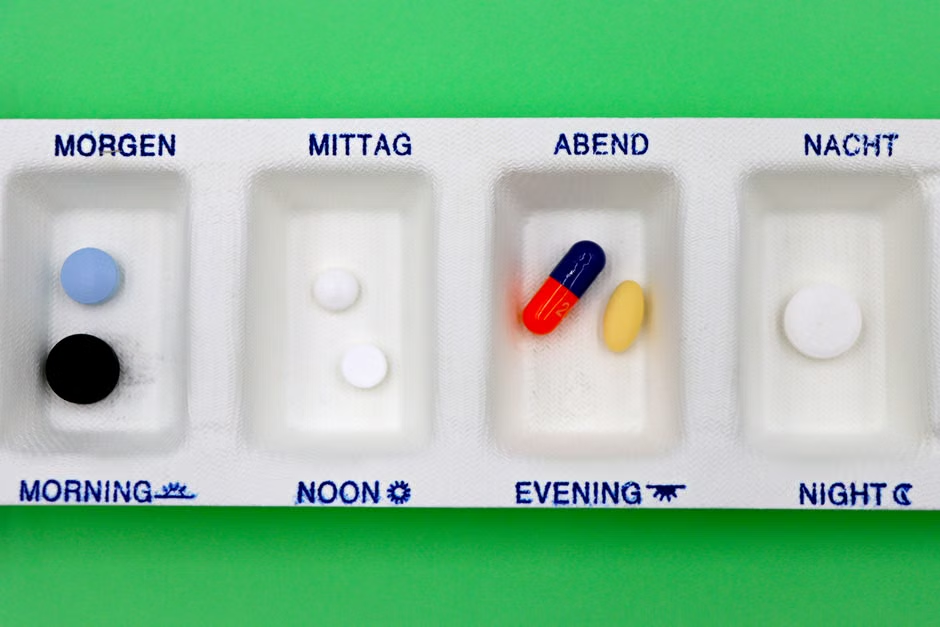
Time-based color coding assigns different visual cues to each administration point in the day. A morning dose might carry a yellow or sunrise-toned band; an evening dose, blue or navy. For patients on twice-daily regimens, where medication abbreviations bid (bis in die, twice daily) appear on the label, a visual time cue removes one layer of interpretation, particularly valuable for elderly patients, those with low health literacy, or anyone managing multiple concurrent therapies.
The approach also works for weekly or monthly medications, common in osteoporosis management and certain antiviral protocols. A single color band indicating “once weekly, Sunday” reduces the risk of double-dosing or missed cycles without requiring the patient to retain a verbal instruction.

Which Medication Types Benefit Most from Color Differentiation?
Not every therapy benefits equally from color-coding. The greatest gains appear where dosing complexity, look-alike risk, or patient vulnerability converge. In our work across European healthcare systems, we consistently see stronger adherence outcomes in these categories:
- Chronic cardiovascular therapies, including statins for cholesterol and antihypertensives
- Antiretroviral and antiviral protocols, including antiviral medication for hepatitis b and PrEP regimens
- Gout management medications requiring clear differentiation between acute-attack and maintenance doses
- Over-the-counter products where similar-looking packaging creates confusion, including some OTC preparations
- Polypharmacy regimens in elderly patients managing four or more concurrent drugs
- Pediatric formulations that must be clearly separated from adult-strength equivalents
- Short-course antibiotics where completing the full course is critical to treatment success
The Healthcare Compliance Packaging Council Europe has documented, through our annual Columbus Award program, that packaging innovation in these high-complexity categories produces measurable downstream effects on treatment effectiveness and hospital readmission rates.
Is Color-Coding Right for Every Patient?
Honest guidance requires saying: no, it isn’t. Color-coding depends on intact color vision. Approximately 8% of men and 0.5% of women have some form of color vision deficiency. For these patients, red-green differentiations carry no information. Packaging systems that rely solely on hue, without shape, pattern, or typographic backup, may create a false sense of safety.
This is why the strongest packaging design frameworks use color as one layer within a redundant system: distinct shape cues, tactile differentiation, clear pictograms, and consistent placement of key information. For patients with significant visual impairment, blister compliance aids and pharmacist-prepared dosette systems remain the most reliable alternatives. Digital reminder tools and app-based medication tracking add another layer for tech-comfortable patients, though these are complementary, not substitutes for well-designed physical packaging.
“Adherence to long-term therapies in developed countries averages only 50%, and adherence is even lower in developing countries.”
— World Health Organization, Adherence to Long-Term Therapies: Evidence for Action
That 50% figure holds even where packaging is reasonably clear. It underscores that no single packaging intervention closes the adherence gap on its own. Color-coding is a meaningful component of a patient-centered design system, not a solution in isolation.
What Outcomes Can Patients and Providers Realistically Expect?
Expectations should be grounded in evidence, not optimism. Studies on compliance-enhancing packaging design suggest consistent, if modest, improvements in adherence rates when color-coding is implemented alongside clear labeling and patient education. The European Society of Cardiology has cited data showing a 25% reduction in cardiovascular events among patients with high adherence to antihypertensive regimens, though that outcome reflects adherence broadly, not packaging design specifically.
Realistic timelines for observing outcomes look roughly like this: within the first 30 days of switching to a color-differentiated pack, patients with low prior adherence often show improved dose consistency. Over three to six months, the effect on clinical markers, such as controlled blood pressure or stable lipid panels, becomes measurable. Beyond six months, the compounding benefit of sustained adherence, fewer missed doses, fewer rescue interventions, begins to reflect in healthcare utilization data.
These are not transformations. They are incremental, meaningful improvements that accumulate across entire patient populations. When scaled across European healthcare systems managing millions of chronic patients, even a few percentage points of adherence improvement represents substantial clinical and economic value.
Practical Steps for Packaging Designers and Healthcare Providers
If you’re working on a packaging brief or advising on dispensing systems, Renato Lemay and others who cover this space consistently point to the same evidence-based principles:
- Use color as one layer within a redundant visual system, never as the only differentiator.
- Align color choices with established national or international formulary standards to avoid creating new look-alike risks.
- Test designs with real patients across age groups and visual ability profiles before finalizing.
- Pair time-based color cues with clear dosing schedules printed in large, high-contrast type.
- Ensure that color-coding is consistent across an entire product line, not introduced only for one SKU in a range.
- Brief pharmacists and prescribing clinicians on any new color system so they can reinforce it at point of care.
Turning knowledge into action requires coordination across the supply chain. Manufacturers, regulators, and dispensing professionals all have a role in making color-based systems work in practice, not just in theory.
HCPC Europe brings these stakeholders together through structured programs, including our Columbus Award, which has recognized practical packaging innovation from major pharmaceutical manufacturers for over a decade. The award process itself generates real-world evidence of what works, which we share through our Research and Best Practices program to help the broader industry move faster toward patient-friendly design.
Color-coded packaging is not a cosmetic choice. When designed with rigor, tested with patients, and implemented consistently, it is one of the clearest examples of how packaging design serves as a communication tool between the healthcare system and the person who ultimately decides whether to take their medication. Better packaging means better compliance. Better compliance means better outcomes. That chain of cause and effect is what drives this work, and it is why the details matter as much as the ambition.